

OUR FEATURED NEWS
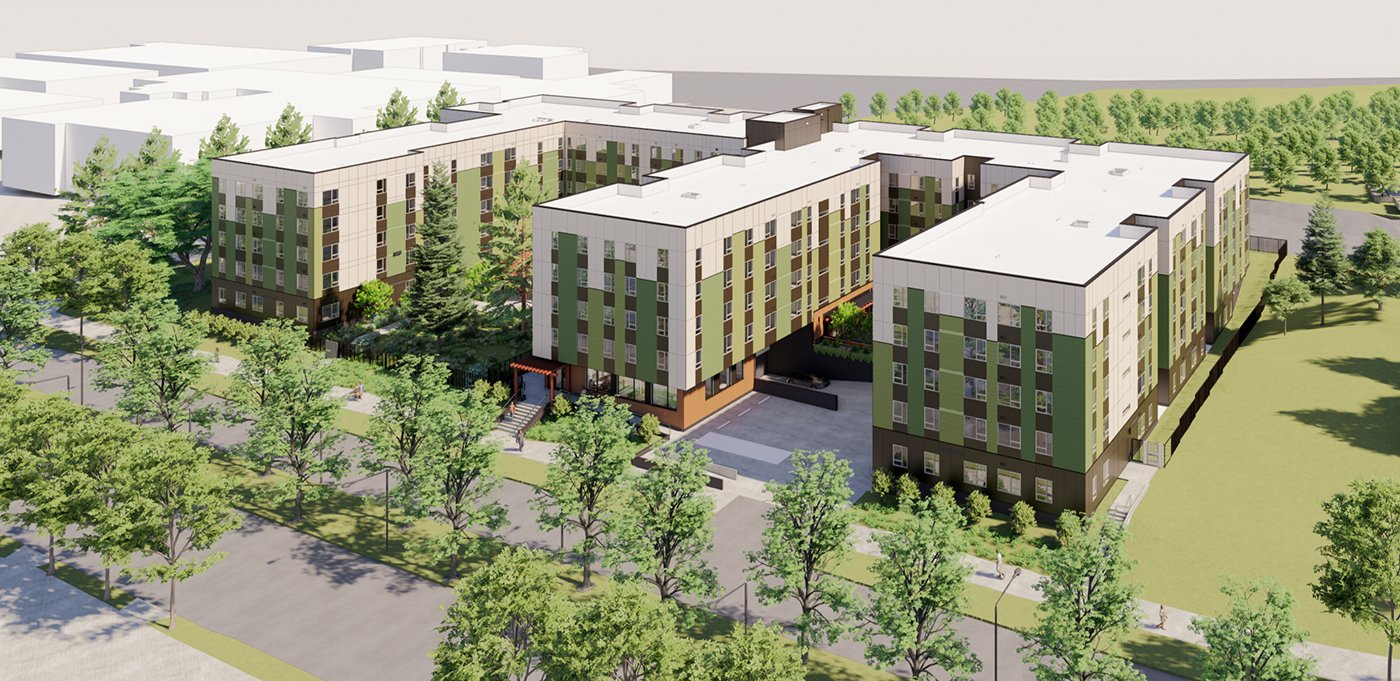
Rendering: Runberg Architecture Group
Read the original Daily Journal of Commerce article by Nina Milligan here, published on August 26, 2026
daily journal of commerce
THUNDERBIRD NEST TAKES SHAPE IN SEATTLE’S LICTON SPRINGS NEIGHBORHOOD
A recent article from the Daily Journal of Commerce highlighted Thunderbird Nest, a future affordable housing community being developed through a partnership between Chief Seattle Club and Bellwether Housing.
Located in Seattle's Licton Springs neighborhood, Thunderbird Nest represents more than a housing development. It reflects a shared vision for creating spaces where Native families can thrive, stay connected to community, and build futures rooted in belonging.
Thunderbird Nest will bring approximately 200 affordable homes to Licton Springs, with a strong focus on family housing and community-centered design. The project is moving through permitting and design and is one of the early projects participating in Seattle's Roots to Roofs program. Thunderbird Nest construction begins in 2027 and aims to open in 2029.
For Chief Seattle Club, housing has always been about more than a roof overhead. Safe, stable housing helps create the foundation people need to stay connected to culture, strengthen family relationships, and build healthy futures.
We're grateful to Bellwether Housing for their partnership and commitment to bringing Thunderbird Nest to life and to the Daily Journal of Commerce for highlighting the project and the opportunities created through community-led development.
Read More
Read the original Daily Journal of Commerce article by Nina Milligan
Learn more about Thunderbird Nest through Bellwether Housing

Public Health Insider — August 24, 2026
PUBLIC HEALTH INSIDER
OFFICIAL INSIGHTS FROM PUBLIC HEALTH - SEATTLE & KING COUNTY STAFF
OPENING DOORS WHEN PEOPLE ARE READY
It’s not easy for many of us to ask for help. When it comes to substance use, feelings of shame, stigma, and past negative experiences can make asking for help even harder. For people seeking substance use treatment, the complex system of providers and options can be an overwhelming barrier, especially for people with other challenges like housing instability or other mental health conditions.
When someone does feel ready to ask for help, time is of the essence, according to Brandon Whitehead, Shelter Services Director at Chief Seattle Club. “When people say that they’re ready for help, it’s a very small window of opportunity for you to act,” Whitehead said. “It’s critical to act when people come to you and say that they need help.”’
But for many service providers, acting immediately is difficult. Everyone has different needs when it comes to treatment, and finding the right program that has openings can be a complex, time-consuming process.
A new partnership for community-based services
In 2025, Chief Seattle Club and Evergreen Treatment Services (ETS) launched a pilot program to provide a solution. Supported with King County Opioid Settlement Funds, these organizations partnered to bring a substance use disorder counselor to the Native-led housing and human services agency’s Pioneer Square Day Center. The counselor, who is an ETS employee and works at Chief Seattle Club’s site, provides immediate, one-on-one support to any member who comes to the day center and asks for help. Since launching the pilot last year, the program has provided over 500 client engagements and referrals to services for Chief Seattle Club members.
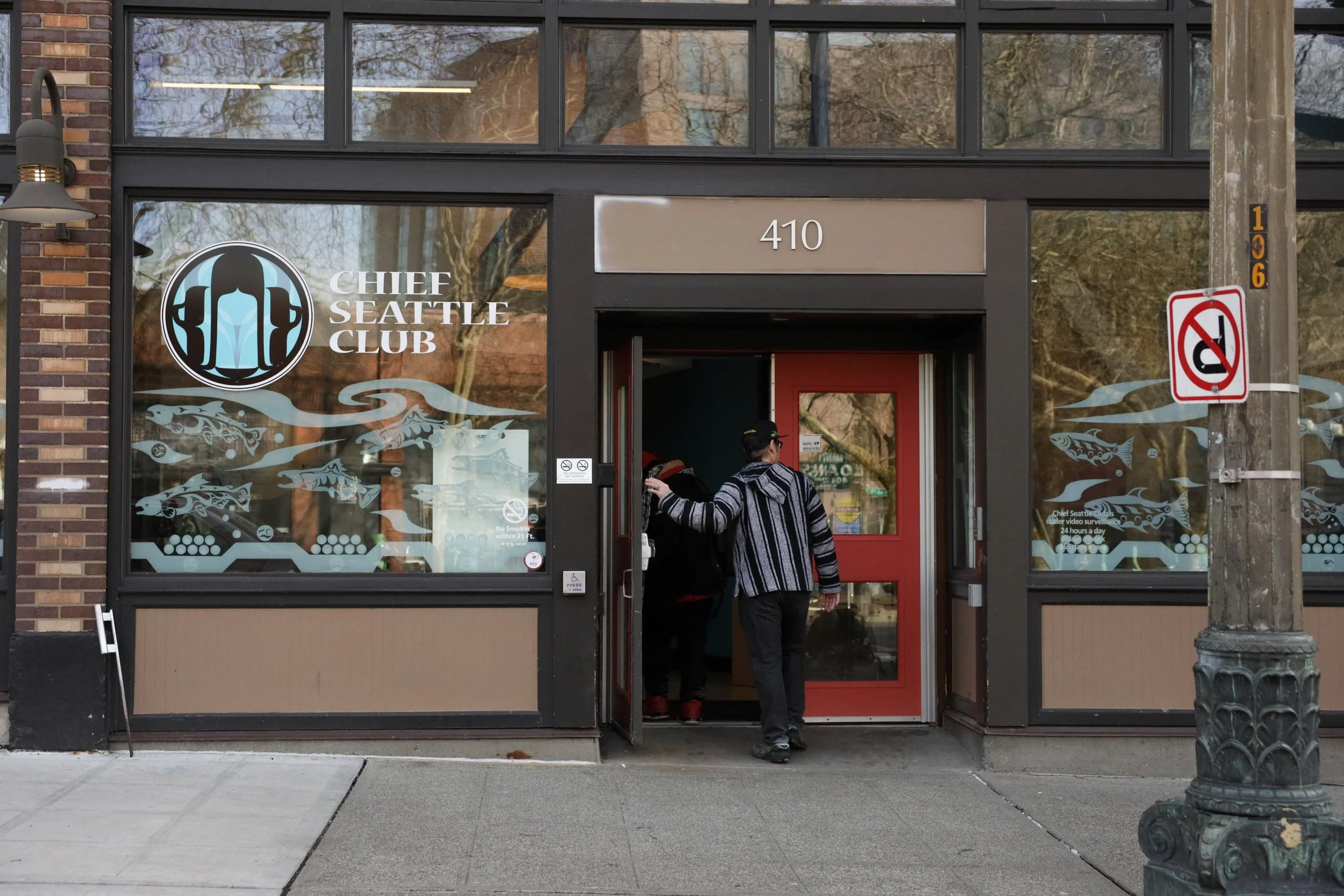
Image by Francisco Sanchez for Chief Seattle ClubThe partnership is just one example of how communities are using opioid settlement funds to connect people to treatment, resources and support. King County’s 10 opioid settlement partners provide a wide range of innovative community-based services to address the harms of opioids in our community. These include overdose education, naloxone distribution, grief support, and more.
Immediate referral to culturally responsive support and treatment
Within just a few minutes of walking in the door and asking for support, Chief Seattle Club members can find themselves sitting with an ETS substance use disorder counselor to discuss treatment options. The two organizations worked closely to develop a specialized resource library of treatment options in the area that provide culturally responsive care for the Native population. Members can do a clinical intake to assess their needs and get a referral to the right treatment, all without leaving the building. In as little as a few days, they’re on their way to treatment and recovery.
“Funding from the opioid settlement allowed us to partner with CSC to break down traditional barriers to care. We’ve been able to embed a staff member directly in the community for the first time,” said Christine Beeman, Director of Clinic Operations at ETS. “This collaborative approach has opened new doors and inspired our organization to rethink how and where we deliver vital services. It has been a really amazing and eye-opening experience for us.”
“Our members are willing to trust us to coordinate care for them and trust us to set up treatment and to follow through. To me that is success.”
While ETS navigates placement into treatment, Chief Seattle Club provides important follow-up and support. They also help members get identification and work with ETS to arrange transportation if they need a treatment option outside of the immediate area.
Building trust through ongoing partnership
Each person’s recovery journey is different. At Chief Seattle Club, Whitehead has seen members who have been able to get their lives back on track with housing and employment. But many people may need to access treatment services multiple times before they find lasting recovery. For Whitehead and Beeman, the pilot’s bigger success is in the number of individuals who start the process and trust that culturally competent help will be there when they need it.
“We have members that are willing to go and sit down and open themselves up to ETS,” said Whitehead. “Our members are willing to trust us to coordinate care for them and trust us to set up treatment and to follow through. To me that is success.”
Whitehead and Beeman hope that the program can be replicated as a model for other day centers and services providers to embed clinical intake services at their locations.
“Even on days where we just get one person that walks to the door and wants to get that help,” said Whitehead, “I consider that a win.”
Learn more about the King County Opioid Settlement.
Originally published August 24, 2026, on Public Health Insider

For Immediate Release — June 23, 2026
MEDIA STATEMENT
Native Homelessness is 4.2% Reports King County Regional Homelessness Authority
Count reflects “serious flaws and an undercount of Native homelessness”
Seattle, WA—The King County Regional Homelessness Authority (KCRHA) released its 2026 Point-in-Time Count of unsheltered individuals. Initial data showed 4.2% of individuals identified as American Indian, Alaska Native, or Indigenous. The following statement from Derrick Belgarde (Siletz & Chippewa-Cree), Chief Executive Officer of Chief Seattle Club, can be quoted in full or in part.
“Just like the 2024 Point-in-Time Count, the 2026 data from KCRHA appears to reflect serious flaws and an undercount of Native homelessness. If the data is to be believed, there has been a 10.8% decrease in Native American and Alaska Native homelessness since 2020. While we’ve certainly made some headway in housing our Native relatives, we are nowhere near that level of progress. Flawed data isn’t just a theoretical problem, it puts the lives of our most vulnerable relatives at risk.
In order to solve Native homelessness, we need to have an accurate picture of the problem. Past numbers have shown that chronic homelessness in King County’s Native population is higher than any other demographic. We must understand just how many of our relatives remain unhoused in order to address their housing and shelter needs.
The 4.2% number points to serious flaws in how we collect data on Native homelessness. First, KCRHA relies on people reporting to a central hub to have their data collected. We know from our work that there is great distrust by Native peoples in reporting to people outside their community. And, in this current political environment of ICE sweeps and detention, we would anticipate that an even smaller percentage of our relatives would be willing to go to a designated location to have their data collected.
Organizations serving urban Indians are already vastly under-resourced. These inaccurate numbers endanger critical funding that we rely upon to house and shelter our Native relatives. Chief Seattle Club cannot afford to lose another dollar of life-saving funds.
We believe the count from 2020 is more accurate and reflects what we are seeing on a day-to-day basis. American Indians and Alaska Natives make up less than 2% of the region’s overall population, but 15% of our homeless population, and 32% of the chronically homeless population. The assimilation, eradication, and relocation policies over the last century have created an urgent homelessness crisis for Native peoples. King County and the City of Seattle have an obligation to the original peoples of these lands to put more resources and effort behind understanding the extent of Native homelessness. We cannot have one more Point-in-Time Count that does not do the job of counting the actual number of unhoused American Indians and Alaska Natives.
Chief Seattle Club’s place as the county’s only urban Indian housing and homelessness services provider is a sacred role. Our work isn’t done until every one of our Native relatives has a safe, secure place to live indoors and off the streets.”
###
Media Contact:
Brad Angerman
Pyramid Communications
702-218-4490
bangerman@pyramidcommunications.com
About Chief Seattle Club
Chief Seattle Club is Seattle’s only Native-led housing and human services agency dedicated to the physical and spiritual health of the chronically homeless American Indian and Alaska Native community it serves. The organization currently operates five permanent supportive housing facilities and two non-congregate shelters throughout King County. They also operate a Day Center in the Pioneer Square District of downtown Seattle that creates a supportive community for its members while providing hot meals, housing assistance, and access to health services and cultural activities. Learn more at chiefseattleclub.org/.
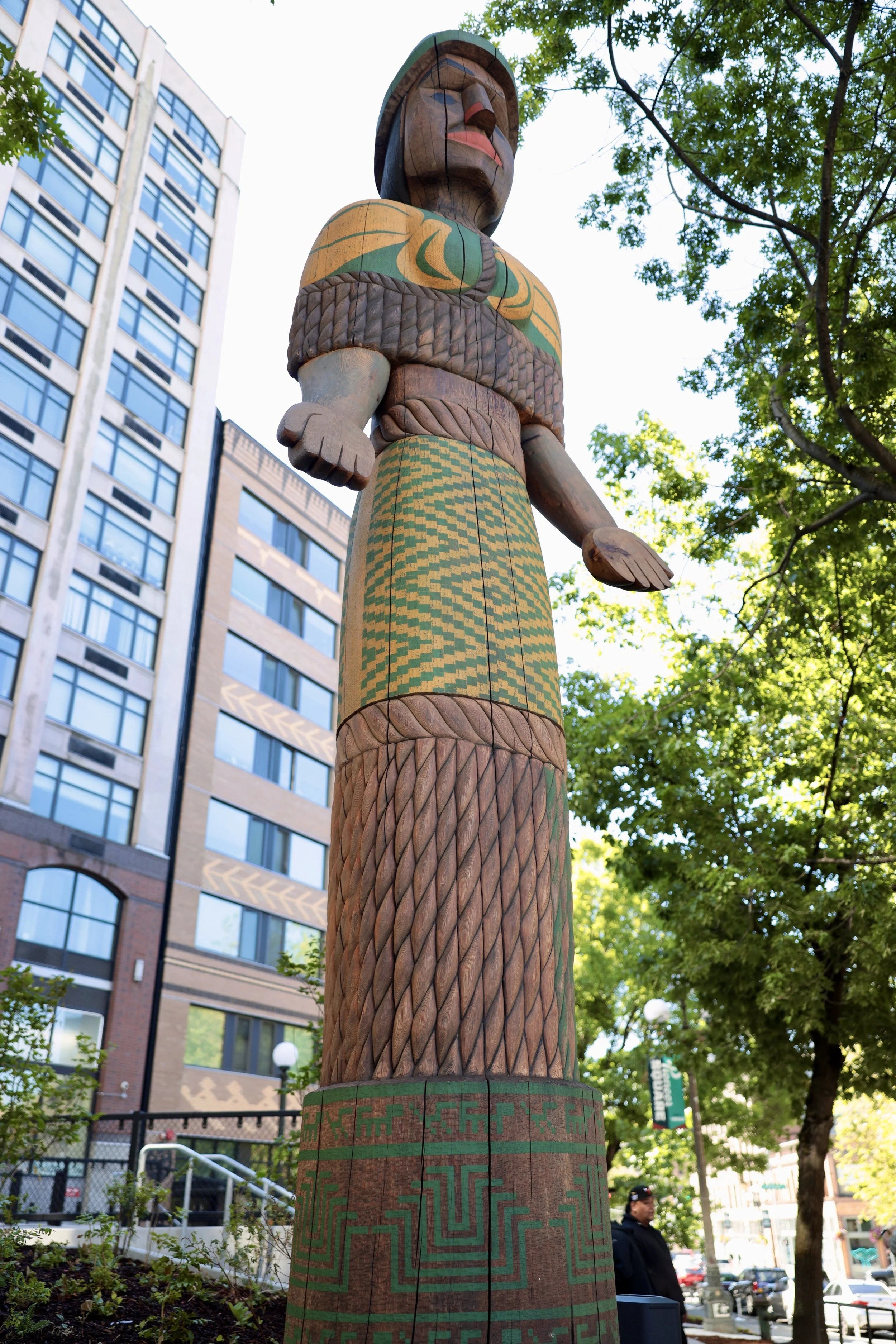
Chief Seattle Club Unveils Welcome Figure
Native-led organization marks years of planning with public artwork that welcomes all to these lands
June 11th, 2026
SEATTLE, WA — June 11, 2026 — Chief Seattle Club (CSC) will host a Welcome Figure Grand Opening Ceremony on Thursday, June 11 at 10:00 AM, celebrating the unveiling of a commissioned artwork carved by Andrea M. Wilbur-Sigo (Squaxin Island Tribe). The Welcome Figure, created to honor Grandmother Frog, stands facing the sea and serves as a welcoming presence to all who enter this space. This moment reflects years of planning and community vision. As a Native-led organization serving urban American Indian and Alaska Native people, CSC continues to create spaces that center belonging, dignity, and cultural grounding in both physical and symbolic ways.
The story of Grandmother Frog carries teachings of connection, resilience, and care across generations. She is known as a gatherer, a provider, and a keeper of family and community. Her presence represents the continuity between land, water, sky, and people — reminding us that we are connected across generations and responsible to one another. In this way, the statue stands not only as a work of art, but as a living reflection of relationship, care, and welcome.
"This statue represents more than a physical structure — it reflects our commitment to creating spaces of belonging and cultural connection for our community," said Derrick Belgarde (Siletz and Chippewa-Cree), Chief Executive Officer of Chief Seattle Club. "It welcomes our members, relatives, and all who enter with a spirit of respect and shared humanity."
The grand opening ceremony will include opening remarks from CEO Derrick Belgarde, an opening prayer and song, remarks from artist Andrea M. Wilbur-Sigo, opportunities for partner and funder voices, and a closing.
EVENT DETAILS:
Date: Thursday, June 11
Time: 10:00 AM
Location: Fortson Square, 103 2nd Ave S, Seattle, WA 98104 / Outside Chief Seattle Club (410 2nd Ave Ext S, Seattle, WA 98104).
Media are welcome to attend. Interviews and visuals can be coordinated in advance or on-site.
Chief Seattle Club is the only Native-led housing and human services agency that serves Seattle’s urban Native homeless community, which disproportionately makes up 15% of total and 32% of chronic homelessness across King County. With its community-led, culturally grounded emergency services, shelters, and permanent support housing, Chief Seattle Club addresses chronic homelessness at all stages to nurture, affirm, and strengthen the spirit of urban Native people.
Trump Signs Order to Remove Homeless from the Streets
Seattle, WA - July 25, 2025
Action is “especially cruel” given federal defunding says Native housing provider
Seattle, WA – President Trump recently signed an executive order that would make it easier for jurisdictions to remove homeless people from the streets. The following statement from Derrick Belgarde (Siletz/Chippewa-Cree), CEO of the Chief Seattle Club, can be quoted in-full or in-part.
“The Trump Executive Order punishing jurisdictions that do not remove visible signs of homelessness is an especially cruel act from an administration that has gutted federal funding for housing solutions, behavioral health, and proven treatment and recovery programs.
It’s unfortunate that lawmakers continue to criminalize homelessness instead of working towards solutions that safely house and protect our most vulnerable relatives.
The order specifically calls out housing first solutions, a data-proven method of housing our relatives who are struggling with substance use disorder and mental health crises.
At Chief Seattle Club, we know that providing a safe and permanent place to live and sleep makes it easier to bring people long-term stability. Recent King County data shows that housing first led to fewer emergency room visits for our unhoused relatives. This isn’t surprising. We’ve seen firsthand through our work as housing providers the ways in which people transform through stable housing. Their health improves, their ability to maintain employment improves, and their chances of long-term sobriety greatly increases. At Chief Seattle Club, we believe housing comes first and then you can bring people the services they need. And with time, we can bring our Indigenous relatives the culture and ceremony that creates even greater stability and health.
As a nation, and as a community, we have seen more and more movement towards encampment sweeps. We must become more uncomfortable as Americans with the idea that people are living on the cold, wet streets than we are with the sight of unhoused people. The issue is not with visible litter or tents on sidewalks, but with the very fact that, as the richest nation in the world, we are failing our most vulnerable citizens through a lack of political will to fully fund the necessary solutions to homelessness.”
Homeless people visited ER less after moving into King County’s hotels
July 21, 2025 - Greg Kim
We offer housing-first principles with our culturally-informed Day Center that supports community-building, and life and sobriety skills. Shelter beds, alongside the traditional healing that we deliver, are a fundamental part of our ability to bring our relatives indoors. Read more about the housing first model and why it works.
Chief Seattle Club to Open Fifth Permanent Supportive Housing Facility since 2022
New 84-unit facility to provide housing for individuals exiting chronic homelessness
July 16th, 2025
Seattle, WA—In September, Chief Seattle Club will be opening Sweetgrass Flats, an 84-unit permanent supportive housing facility located in Seattle’s Yesler Terrace neighborhood. The facility will provide stable housing for Native peoples that are exiting chronic homelessness.
Chief Seattle Club purchased the $29 million facility with funding from the City of Seattle, King County, the State of Washington, and LISC Puget Sound. The Club acquired the newly constructed building following the cancellation of a planned apartment development. Renovations are currently being made to accommodate operational needs.
“We’re deeply grateful to our partners who recognize the impact we’re making and choose to invest in our vision,” said Derrick Belgarde (Siletz), chief executive officer of Chief Seattle Club. “With the upcoming opening of Sweetgrass Flats, we’ll be operating five permanent supportive housing facilities — 423 units in total — all opened since 2022. That’s 423 homes for a Native community that has too often been overlooked and underfunded.”
According to the 2020 Seattle/King County Point-In-Time Count, American Indians and Alaska Natives make up more than 30% of the chronically homeless population, despite representing less than 2% of King County’s total population. Chief Seattle Club references the 2020 report because it was more thorough due to better collaboration with Native organizations.
Since 2022, the organization has opened four other permanent supportive housing facilities: the 80-unit ʔálʔal building in Pioneer Square (2022); the 76-unit Salmonberry Lofts in Pioneer Square (2023); the 63-unit Goldfinch senior apartments in Fremont (2023); and the 120-unit Sacred Medicine House in Lake City (2024).
Chief Seattle Club also operates two non-congregate shelters called Eagle Village and Raven Village. These shelters play an important role in Chief Seattle Club’s housing model, preparing residents for successful transitions into the permanent supportive housing. Most of the residents that are currently in these shelters will be moving into Sweetgrass Flats when it opens.
“A safe place to call home is the foundation for healing. Opening the doors of Sweetgrass Flats brings us one step closer to ensuring that every Indigenous neighbor in King County has that opportunity,” said King County Executive Shannon Braddock. “We’re honored to partner with Chief Seattle Club—together, we’ve helped create more than 200 supportive housing units for Native American and Alaska Native community members since 2019. Their unwavering commitment and powerful vision to end homelessness is a call to action we must all answer.”
Click here for photos of the facility.
Chief Seattle Club Announces $3m Ballmer Group Grant Award
November 14th, 2024
Seattle, WA—Chief Seattle Club (CSC) is honored to be awarded a $3 million grant from Ballmer Group. This generous support will play a pivotal role in advancing Chief Seattle Club’s mission to provide vital services and housing to our Native relatives in Seattle and King County.
“Key partnerships like this one with Ballmer Group, move us forward in caring for our community members,” said Chief Seattle Club Executive Director Derrick Belgarde (Siletz). “We are deeply grateful to the Ballmer Group for making this transformative investment in CSC’s work to strengthen our community. We will ensure that every dollar contributes to our mission of creating sacred space for Native people through affordable housing development in Seattle and King County”.
Specifically, CSC will expand:
Development of our behavioral health department, which will provide trauma- and culturally-informed behavioral health care throughout the organization and at each location.
Traditional wellness operations to ensure that Native people have access to Native cultural practices and spaces.
Programmatic offerings and the amount of wraparound support that our residents, particularly with high acuity, need and deserve.
Operational and administrative support so that our staff can rely on the most efficient systems and effective tools while serving residents.
With this support, Chief Seattle Club will be able to expand their capacity to provide the highest level of service and care to our relatives who experience homelessness at the highest rates in Seattle and King County."
For questions regarding this grant announcement, or if you are interested in learning how you can also support our work, please contact Chief Community Development Officer, James Lovell, at james@chiefseattleclub.org.

Exterior of Sacred Medicine House facing Lake City Way NE
Chief Seattle Club opens new supportive housing facility in North Seattle
April 12, 2024
Seattle, WA—Named Sacred Medicine House, the facility will provide residents access to a number of amenities, including a large activity room, common area kitchen, resident lounge, consult/talking rooms, clinic exam room for visiting healthcare professionals, central laundry, and landscaped outdoor courtyard. The facility is decorated with Indigenous artwork curated by Eighth Generation. The entry mural was designed by Indigenous artist Stephan Smith (Quinault and Makah).
Residents will begin moving into Sacred Medicine House on April 29.

Chief Seattle Club Celebrates New Building
September 22, 2022
On September 22nd, we officially celebrated the grand opening of ʔálʔal, our very first permanent housing project! From community members to board members, we came together in person for the first time since the pandemic began, honoring the hard work that all our staff and supporters have put in to house our relatives in need. It is with great joy and respect that we work to reclaim Native space for Native people here on Coast Salish lands. Thank you all!

Building Space for Indigenous Need
January 28, 2022 - Chris Aadland
The Chief Seattle Club announces the completion of a nine-floor building with 80 housing units for Indigenous people who were formerly homeless, veterans, or poor.
Read more on Indian Country Today, or visit our page all about ʔálʔal.
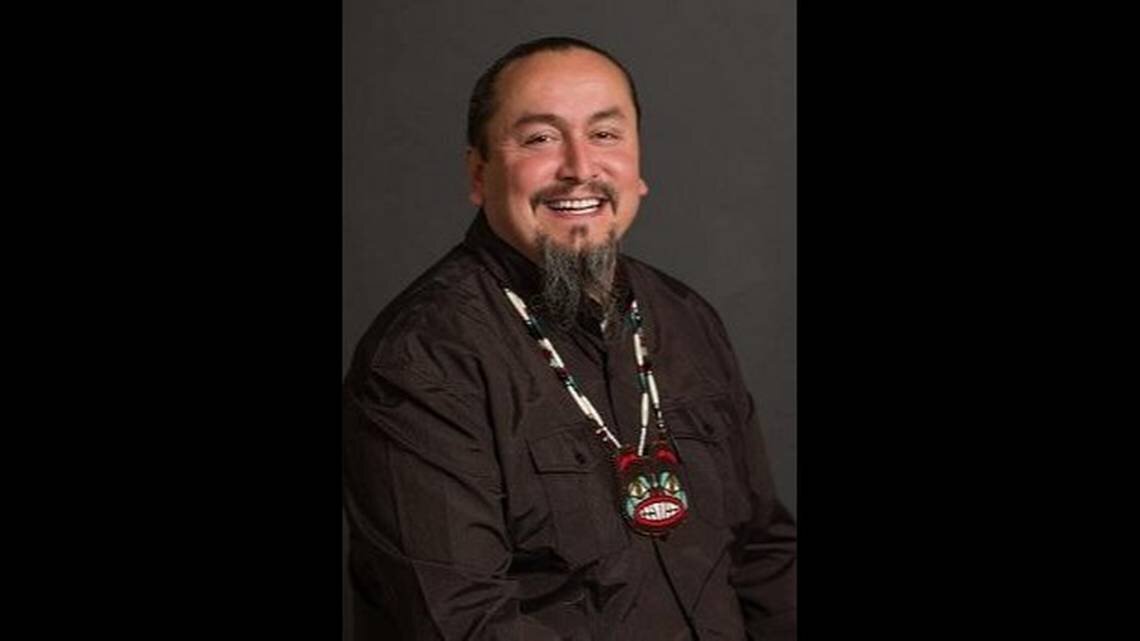
Chief Seattle Club Executive Director Shares Journey from Sobriety to Leadership
October 12, 2021 - Natasha Brennan
"In May of this year, Chief Seattle Club named Derrick Belgarde as its executive director. An enrolled member of the Confederated Tribes of Siletz Indians of Oregon, Belgarde is uniquely positioned to lead the organization...” Link
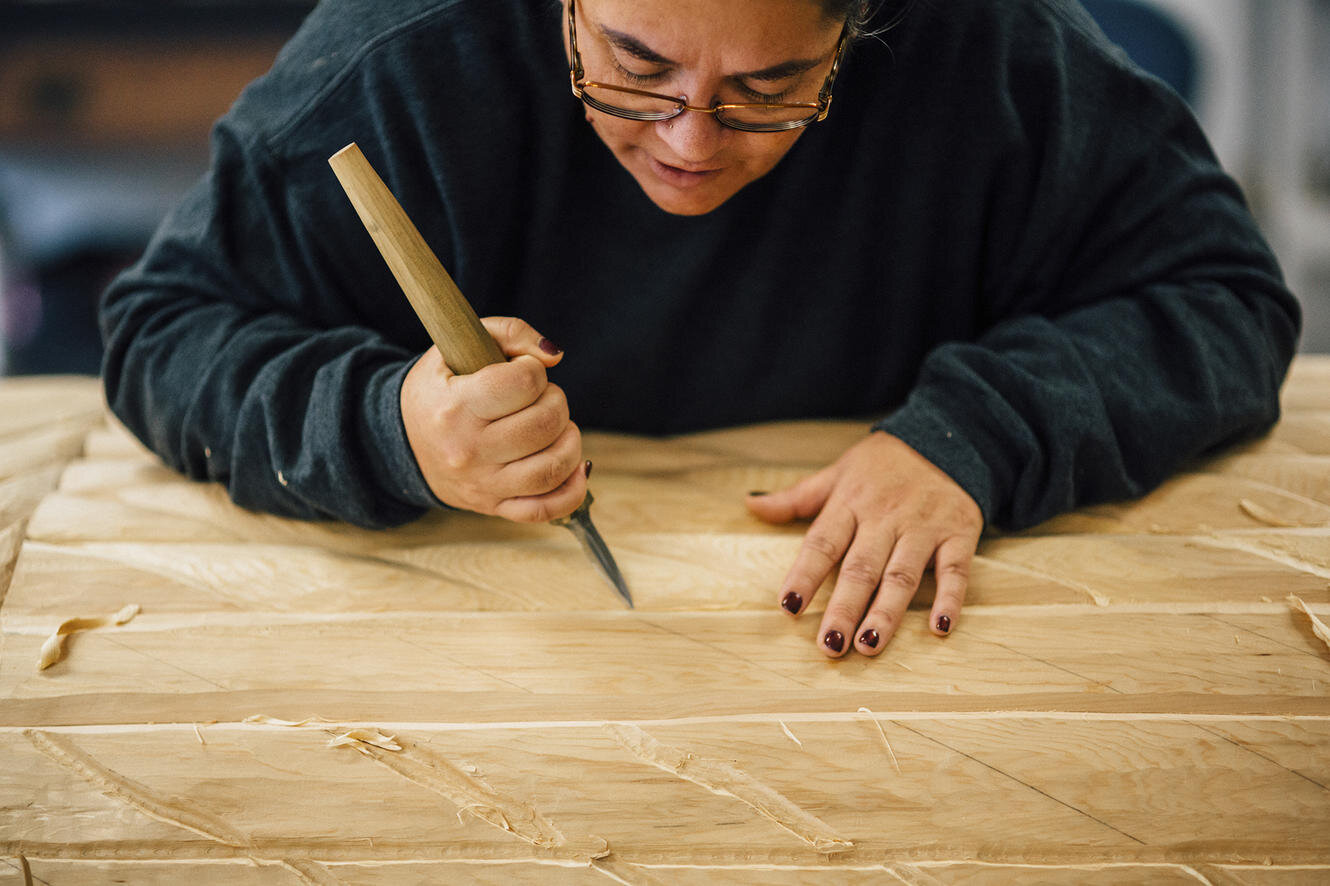
Seattle Is Seeing a Surge of Indigenous Public Art
October 11, 2021 - Margo Vansynghel
“Tack. Tack. Tack. Andrea Wilbur-Sigo whacks a mallet onto the base of a chisel handle with measured force and casual precision. As she pares layers off a long cedar log, the cadence comes naturally. She knows to follow her heartbeat.” Link

Chief Seattle Club Builds a ‘Home’ to Combat Indigenous Homelessness
September 21, 2021 - Benjamin Cassidy
“The nonprofit’s ?ál?al project, a culturally attuned affordable housing development, is set to open soon in Pioneer Square.” Link

The Farm Helping Indigenous Seattleites Reconnect to Their Roots
May 6, 2021 - Emily Nonko
“This March, just south of Seattle, a nearly one-acre farm opened to grow plants and food traditional to Native Americans, with the goal of providing produce for a new cafe that will cook Native foods.” Link

City of Seattle Partners with Chief Seattle Club to Open Hotel-Based Shelter in Belltown with Focus on the Indigenous Community
April 1, 2021 - Kamaria Hightower
“The City of Seattle and Chief Seattle Club today celebrated the opening of the Kings Inn–a hotel-based shelter program with a focus on serving unhoused American Indian and Alaskan Native people.” Link
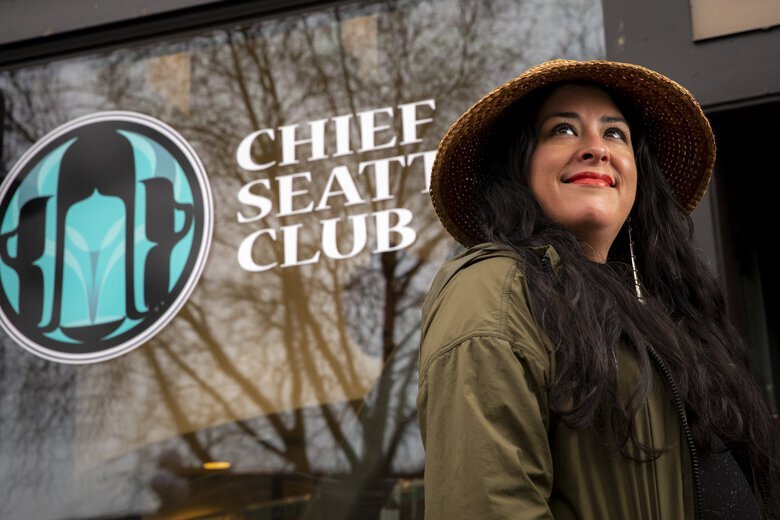
Opinion: Becoming A Good Ancestor
November 26, 2020 - Colleen Echohawk
“The elders always have something to teach us. Sometimes I am so busy, worried, and stressed that I miss it. I miss their quiet and unassuming teaching steeped in hard years of experience that gently guides us.” Link

Racism & Homelessness
June 26, 2020
Derrick Belgarde participated in Project Homeless' panel on racism and homelessness. Belgarde represented Chief Seattle Club, a Native-led organization dedicated to supporting American Indian and Alaska Native people in Seattle. Link

Locking up people with mental health issues won’t help. Here’s what will.
June 22, 2020 - Naomi Ishisaka
“It took 30 years of searching, but Rick Hoffman finally found the healing he was looking for. Since childhood, Hoffman (Santee Dakota Sioux) struggled with generational and familial trauma, abuse, addiction and ultimately, about 12 years of incarceration.” Link

Could the coronavirus reset society? Questions we should be asking about post-pandemic life.
May 21, 2020 - Brandan Kiley
“Hotel rooms for the homeless. Food-chain and sanitation workers hailed as national heroes. A Republican-led federal government flooding the country with easy money. Governors putting the brakes on evictions.” Link
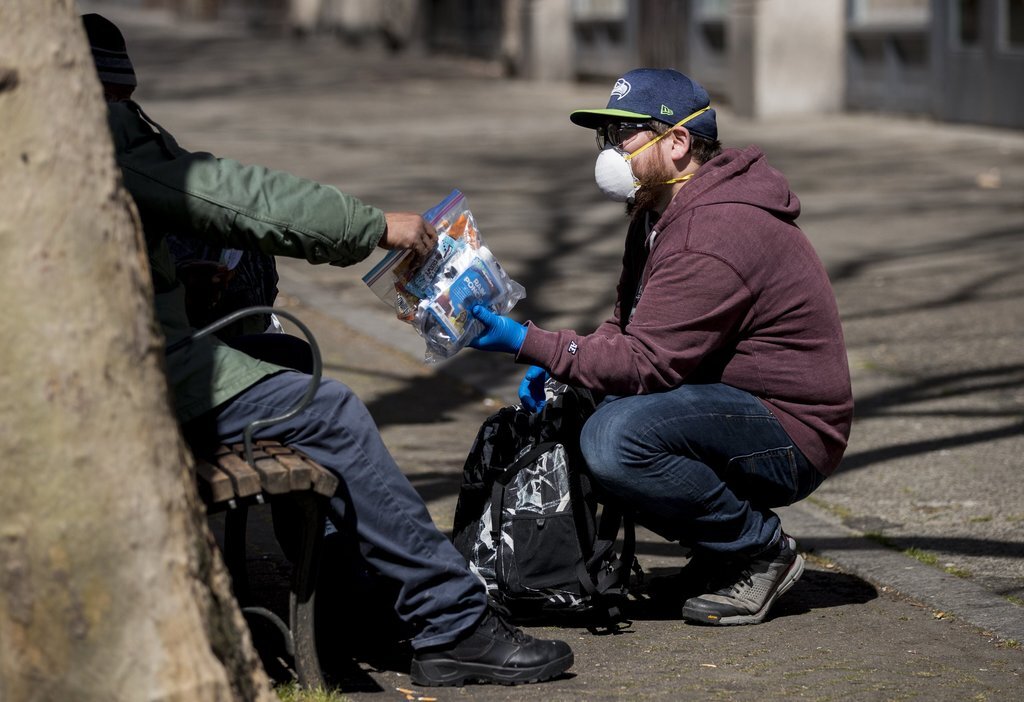
Homelessness amid coronavirus: Drastic times call for radical solutions
April 27, 2020 - Naomi Ishisaka
“Sometimes in our city, it seems like we wait for the bridge to nearly collapse before we realize we need dramatic action to address the cracks in its girders.” Link

Why Native Americans in Seattle Disproportionately Live On the Streets
January 5, 2020 - Carly Stern
“On Veteran’s Day, 15 Native American veterans gathered around a table for a festive seafood lunch at the Chief Seattle Club. Each rose in turn, sharing details about their experiences in the U.S. military.” Link